






Restaurant AI OS

A Smarter Restaurant Starts Long Before the First Order.

Connecting reservations, kitchen operations, staff, inventory and customer experiences in one intelligent hospitality platform.

Explore Restaurant AI (opens in a new tab)Interactive Product Demonstration
Bera Tech AI Restaurant AI OS Executive Command Centre and Operations Pulse

The big idea

Give restaurant owners a clearer view of what is happening—and what may need attention next.

  • Live Service Pulse
  • Kitchen Pacing (KDS)
  • Privacy Camera Vision

Hospitality Technology / Restaurant Operations / Predictive AI / Computer Vision

The challenge

A restaurant can be packed with guests but still lose money during a chaotic shift.

Hospitality is one of the most operationally demanding industries in the world. Margins are slim, timing is unforgiving, and small hiccups compound rapidly.

During a busy dinner service, tables might remain empty while waiting guests stand outside. The kitchen can suddenly become overwhelmed with tickets, blowing out wait times. A signature ingredient can run out unexpectedly mid-service.

Crucially, restaurant operators usually only discover these problems at the end of the night or at month-end when reviewing food waste and labour costs. By then, lost revenue and frustrated guests cannot be recovered.

  • Service Bottlenecks & Table Lag

    Tables sit cleared but unseated while guests wait, reducing covers and dining room turnover.

  • Overwhelmed Kitchen Stations

    Orders flood the pass simultaneously, causing ticket pacing delays and inconsistent dish delivery times.

  • Surprise Ingredient Depletion

    Key dishes must be 86'd mid-shift because inventory monitoring fails to connect prep lists to order velocity.

The solution

A connected hospitality operating system unifying front-of-house, kitchen, and management in real time.

We are developing the Restaurant AI Operating System to bring day-to-day hospitality activities into a cohesive, intelligent environment.

The system coordinates reservations, table occupancy, order pacing, kitchen display workflows (KDS), inventory depletion, and staff scheduling.

Instead of relying on fragmented POS terminals and handwritten prep lists, managers have a unified service pulse that detects friction before it affects diners.

  1. Live Service Pulse & Floor Management

    Real-time visibility over covers seated, table turns, VIP arrivals, and dining room capacity across zones.

  2. Pacing-Aware Kitchen Intelligence

    Monitors station ticket elapsed times, warns chefs before ticket breaches, and balances grill and pass loads.

  3. Predictive Par Levels & Reordering

    Tracks ingredient depletion against sales velocity and prepares supplier replenishment purchase orders.

How it works

  1. Pre-Shift Briefing & Reservations

    The platform projects dinner cover demand and prep requirements.

    Managers review expected guest arrivals, special dietary alerts, and recommended prep quantities before service begins.

  2. Guest Arrival & Table Allocation

    Tables are assigned to optimize server workload and turnaround.

    VIP guests (e.g. anniversary celebrations) are flagged automatically, prompting personalized sommelier notes and welcome gestures.

  3. Synchronised Kitchen Ordering

    Tickets route to kitchen display stations with pacing logic.

    If the grill station begins falling behind on steak tickets, the system highlights the pacing risk before service slows down.

  4. Real-Time Inventory Par Depletion

    Stock counts update automatically as checks are placed.

    When wagyu ribeye inventory approaches its minimum buffer, a draft purchase order for the meat supplier is prepared for manager sign-off.

  5. Post-Service Financial Intelligence

    Shift closes with complete visibility into margins and food waste.

    Managers review gross margin, prime cost ratios (food + labour), and guest feedback without tedious manual reconciliation.

Inside the platform

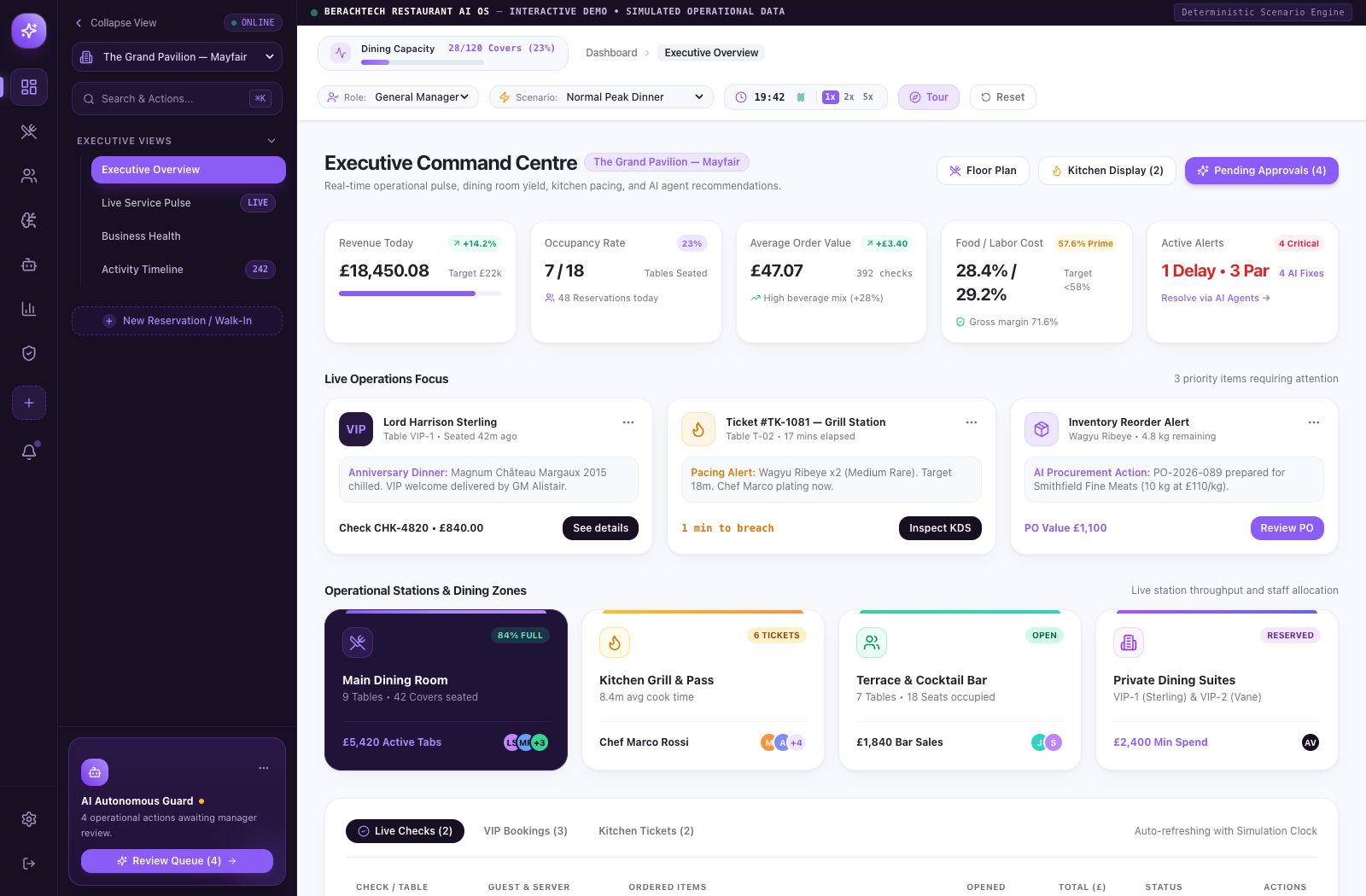
Restaurant AI OS Command Centre displaying live dining capacity, ticket pacing alerts, and zone throughput
Live Interactive Interface

Restaurant Executive Command Centre

The primary operations dashboard monitoring live dining capacity, average order value, kitchen ticket pacing, and inventory alerts.

Dining Capacity Gauge
Tracks live seated covers and occupancy across main dining, terrace, and private suites.
Ticket Pacing Alert
Alerts floor managers when specific station tickets (e.g. grill) approach maximum target times.
AI Autonomous Guard
Queues operational actions (PO approvals, table shifts) for single-click manager review.
AI capabilities

  • Implemented Demo
  • Research Pipeline
  • Implemented Demo

    Smart Reservations & Seating Management

    Smooth out guest arrivals across peak dining hours.

    Spaces bookings intelligently so the kitchen isn't hit with 50 guests sitting down at the exact same time.

  • Implemented Demo

    Connected Kitchen Display System (KDS)

    Synchronise ticket pacing across cooking stations.

    Ensures starters and mains arrive together and warns chefs before tickets breach preparation time targets.

  • Implemented Demo

    Inventory & Ingredient Tracking

    Prevents surprise stockouts during busy services.

    Monitors ingredient usage as orders are rung up, automatically flagging when critical items need reordering.

  • Implemented Demo

    Food Waste Intelligence

    Reduce expensive kitchen spoilage and plate waste.

    Analyses which dishes have high wastage to refine batch prep quantities and portion sizing.

  • Implemented Demo

    Staff Scheduling & Labour Optimisation

    Match floor and kitchen staffing to anticipated guest traffic.

    Helps managers schedule the right number of staff for Friday night surges without overstaffing quiet Tuesday lunches.

  • Implemented Demo

    Restaurant Digital Twin

    Explore hypothetical scenarios for menu pricing and seating layouts.

    Simulate how changing table configurations or adding a set menu could impact revenue and kitchen pacing.

  • Research Pipeline

    Camera Intelligence (Computer Vision)

    Privacy-aware vision to measure floor occupancy and queue lengths.

    Detects unbussed tables and service bottlenecks anonymously to support fast table turns.

What makes it different

  • Unified Floor & Kitchen Logic

    Unlike traditional POS terminals that only register tickets, Restaurant AI OS understands kitchen station capacity before seating more guests.

  • Proactive Service Guard

    Highlights potential problems—such as a ticket nearing its 18-minute breach limit or an ingredient dipping below par—while there is still time to act.

  • Privacy-Conscious Vision Design

    Explores spatial density analysis purely through anonymous geometry and flow models, strictly rejecting invasive facial identification.

Business value

  • Service Harmony

    Smoother Shift Operations

    Reduces service friction between front-of-house staff and kitchen teams during high-volume dining hours.

  • Pacing Discipline

    Better Kitchen Pacing

    Prevents ticket backlogs and cold food at the pass by pacing order arrivals to kitchen station throughput.

  • Waste Reduction

    Lower Food Spoilage

    Ties prep lists and ingredient reorders directly to actual sales speed, protecting restaurant margins.

  • Memorable Hospitality

    Enhanced Guest Hospitality

    VIP preferences, dietary requirements, and anniversary notes are surfaced automatically to servers and managers.

Flagship Innovation Spotlight

What If Your Restaurant Could Understand How Busy It Really Is?

We are researching privacy-aware computer vision concepts designed to help hospitality operators understand physical floor dynamics without compromising diner privacy:
  • Estimate Occupancy Levels

    Measure actual room density and free table capacity anonymously.

    Business impactHelps host staff make accurate walk-in seating promises without walking the floor.

  • Identify Growing Queues

    Detect when host stands or bar waiting areas exceed comfortable thresholds.

    Business impactPrompts front-of-house teams to offer drinks or open additional seating areas.

  • Understand Table Utilisation

    Detect when finished tables are left unbussed during rush periods.

    Business impactAlerts runners to clear tables faster, increasing cover turnaround by several minutes per shift.

  • Highlight Service Bottlenecks

    Observe dwell time at the pass or bar without monitoring individual staff.

    Business impactIdentifies whether delays originate in the kitchen, dishwashing station, or floor service.

Privacy Notice: Computer vision features in the demonstration are simulated conceptual models. The platform does not use facial recognition, customer identity tracking, or live CCTV connections.

Technology & engineering

Engineered with React 19, Next.js, and TypeScript, featuring a deterministic simulation clock, stateful multi-role views, and low-latency UI components.
  • Real-Time Service Dashboard

    • Next.js
    • React
    • TypeScript
    • Tailwind CSS

    Role-switchable interface for General Managers, Head Chefs, Servers, and Hosts.

  • Deterministic Simulation Engine

    • Simulation Clock (1x/2x/5x)
    • Scenario State Machine

    Simulates peak Friday rush, supply shock, and slow lunch scenarios with repeatable consistency.

  • Spatial & Computer Vision Modeling

    • Anonymous Spatial Heuristics
    • Density Flow Concepts

    Conceptual floor map tracking and anonymous occupancy analytics.

Status & future

Interactive Product Demonstration (Bera Tech AI R&D)

This is an active interactive demonstration built by Bera Tech AI to showcase connected restaurant operations.

The figures, venues, checks, and tickets displayed in the demo are simulated demonstration data. Computer vision footage and floor metrics are simulated representations; no live CCTV cameras are connected.

Implemented now

  • Executive command centre with live covers, occupancy, and pacing telemetry
  • Deterministic scenario engine with time acceleration and peak shift triggers
  • Kitchen ticket pacing alerts and supplier reorder proposals
  • Floor zone throughput monitoring across dining room, terrace, and private suites

Proposed enhancements

  • Hardware integration drivers for thermal receipt printers and commercial KDS screens
  • Direct API connectors for Toast, Square, Lightspeed, and OpenTable
  • Automated EDI supplier integration for wholesale meat and produce ordering

Future research

  • Privacy-preserving edge computer vision for automated table turn detection
  • Acoustic kitchen noise modeling to measure ambient rush stress and station overload

More case studies

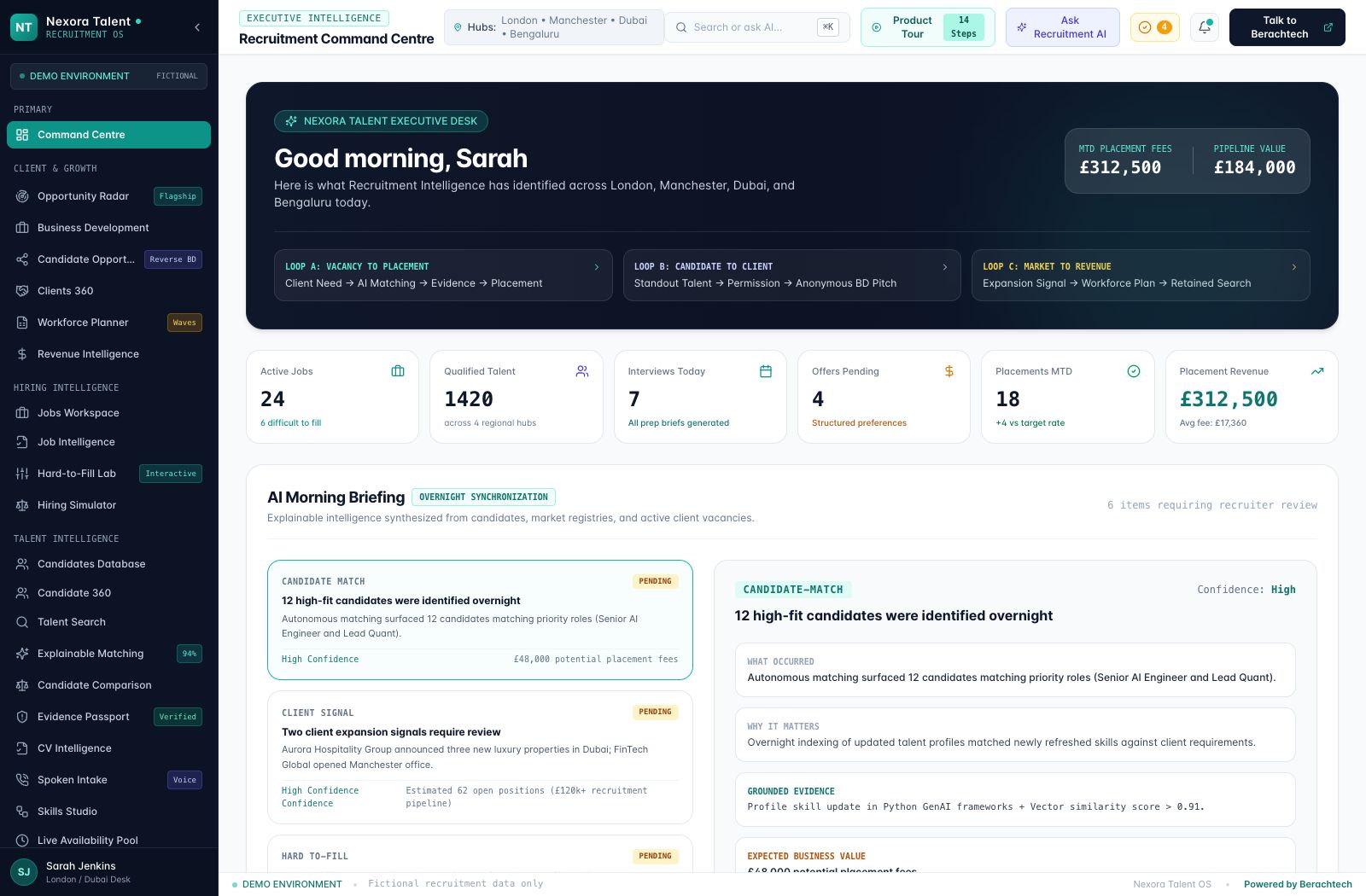
  • Bera Tech AI Recruitment AI OS Command Centre and Morning BriefingLive demo

    Recruitment AI & Talent Matching

    Recruitment AI OS

    An AI-powered recruitment concept designed to help agencies discover opportunities, understand employers and connect suitable candidates with the right roles.

    First-Mover Advantage

    Earlier Client Engagement

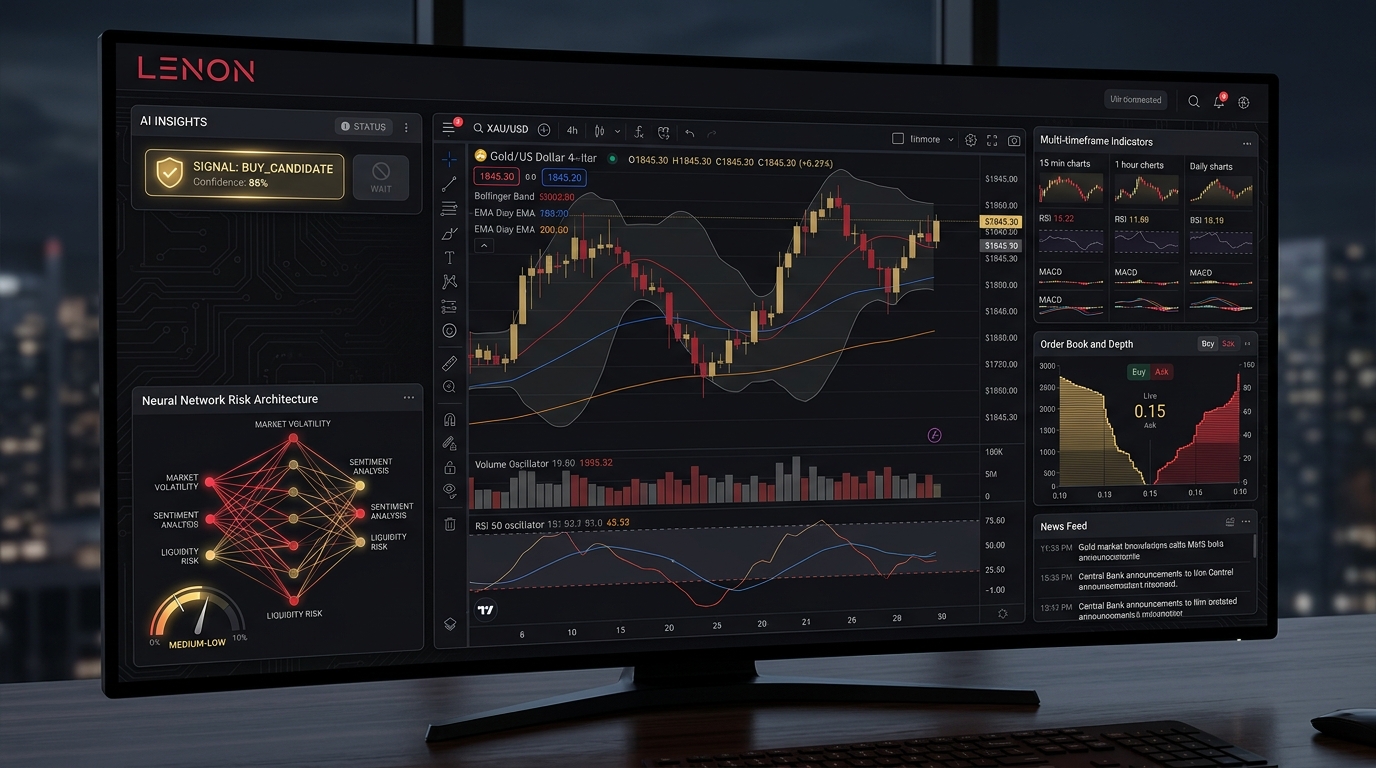
  • LENON Quantitative Trading Intelligence Platform and Risk Architecture Display

    Quantitative FinTech & Risk

    LENON Trading AI

    An engineering-led trading research platform combining market data, quantitative analysis, explainable signals and independent risk controls.

    Emotional Removal

    Disciplined Decision Support

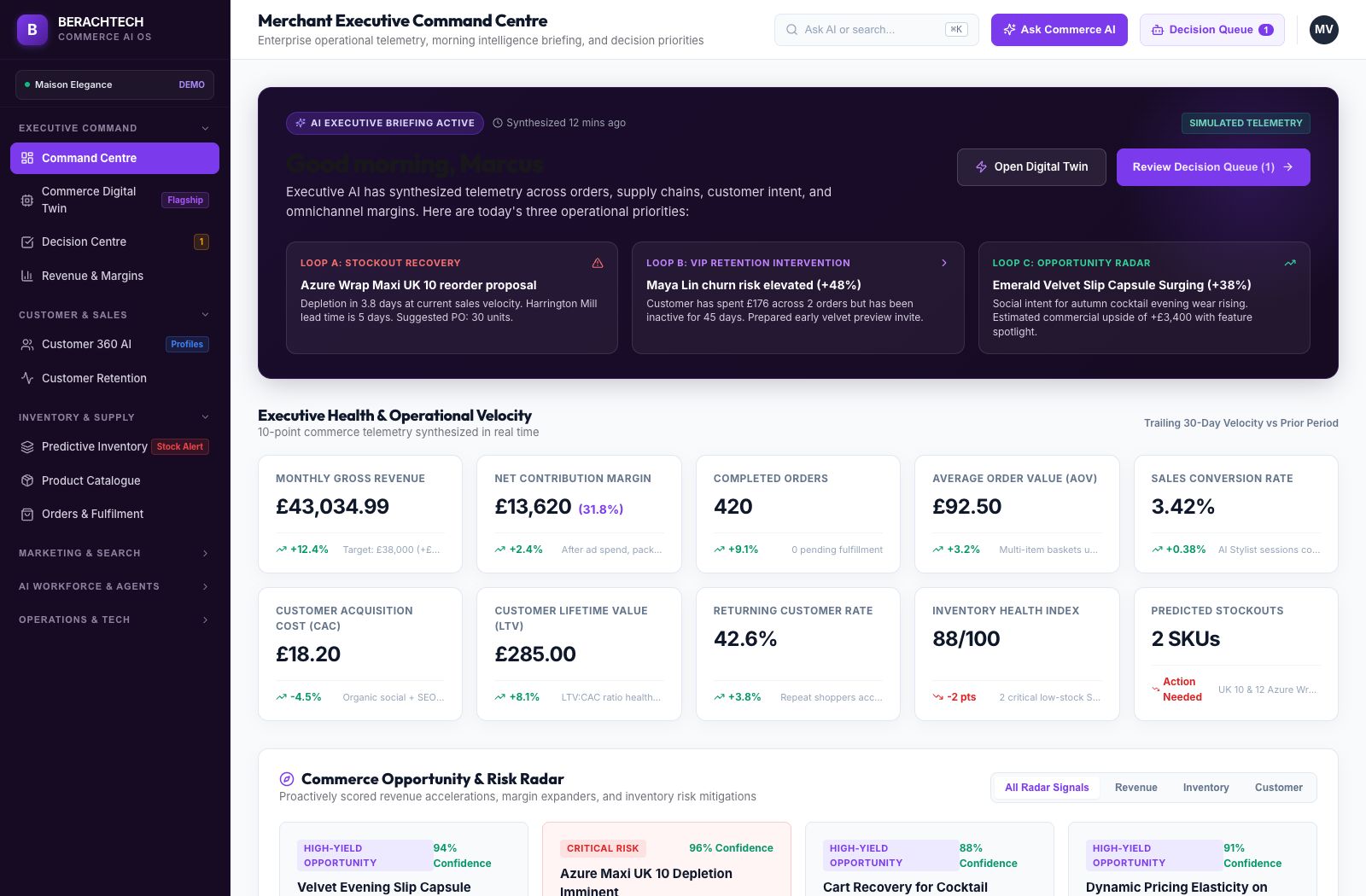
  • Bera Tech AI E-Commerce AI OS Merchant Executive Command Centre InterfaceLive demo

    Retail AI & Commerce

    E-Commerce AI OS

    Reimagining online shopping with natural-language product discovery, personalised assistance and a connected business management experience.

    Frictionless Shopping

    Easier Customer Discovery

Your next chapter startswith a conversation.

Tell us what’s holding you back. We’ll show you where to start.